
01 / 06
Responsibilities are divided first
The head office owns the brand and the products. Each office owns the brand together with its own town and the local searches. This is written into the documentation before anything is built.
Local offices and franchises
When a brand has many offices, the person searching should end up at the right office. We lay a shared foundation for every office. Then we adapt each account to the local market.
This page is written for those of you who run the company or the marketing at the head office of a network with a shared brand. It might be a franchise chain, a dealer network or a company with offices in several towns or countries.
You may be at the head office and want to see the whole picture. Or you run one of the offices and want the customers in your city to find you.
Our experience comes from one of the major car manufacturers with a national importer and dealers all over Sweden. And from an international franchise network that we work with today, with offices in several countries.
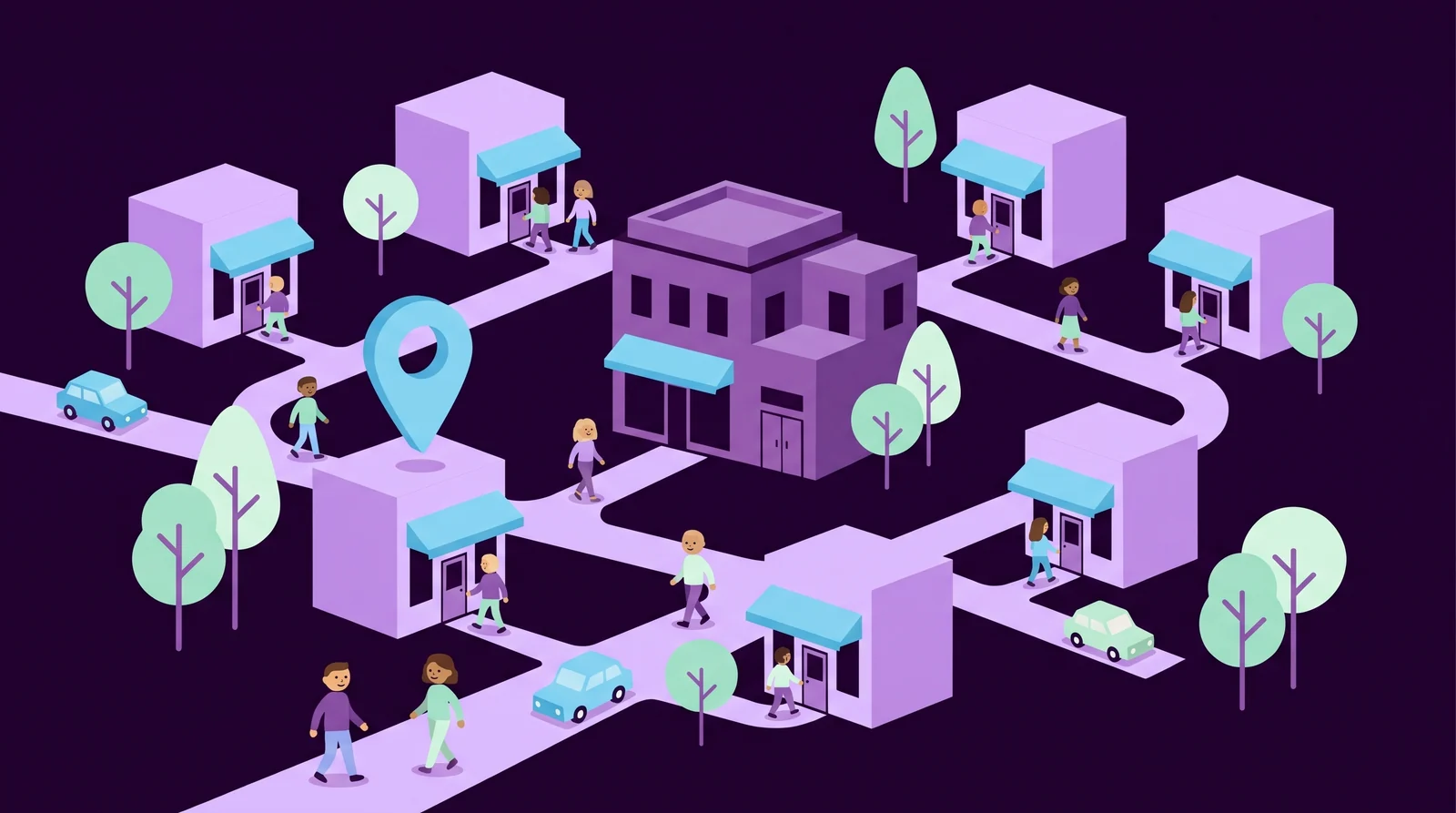
Google's automation is built for one company with one website. In a network with a shared domain the ad for one office can lead the customer to another.
All the offices share the brand but have budgets of their own. Without clear boundaries they pay for each other's customers.
The offices have different budgets, different expertise and different levels of commitment. Some advertise and follow up closely while others do not know what the advertising brings in.
Before we talk about budgets and campaigns we go through the basics. These are what get customers to the right office in any town or country.
Each office has its own Google Business Profile with the right name, address, phone number and opening hours. The link goes to the office's own page.
The page has the address, the phone number and the people who work there. It is available in every language the office advertises in.
The brand and the town are written the same way on the website, in the profile and in the ads. That makes it easier for Google to connect them.
The address, phone number and sitelinks show the office that is advertising. Sitelinks are the extra links below the ad. Google is quick to create its own from across the website and they can lead to another office.
If you have pages for each country or language, Google needs to know which page applies where. Otherwise someone searching in Germany can end up on the Swedish page.
The head office has access to every office's profiles, ad accounts and analytics. Otherwise there is no way to keep the details correct.
The same details are used by Google Maps and by AI services such as ChatGPT when someone asks for an office in a particular city. If they match everywhere, it becomes easier to give the right answer.
The first thing we decide is who owns which search. Otherwise the offices bid against each other and the network pays to compete with itself.
| Search | Example | Owned by |
|---|---|---|
| The brand | “brand” | Head office |
| Products and models | “model name” | Head office |
| The brand and a town | “brand Uppsala” | Uppsala office |
| Local searches | “service Uppsala” | Uppsala office |
The head office pays for searches on the brand alone. The brand belongs to the whole network and should not come out of a single office's budget.
Each office can have two campaigns that mirror each other. One captures searches that include the town from anywhere in the country. The other captures searches without a town from people nearby. Someone in Stockholm who searches for the brand and Uppsala still ends up at the Uppsala office.
The boundary is never completely tight. Some of the visitors from one office's ad go on to another office's pages and that is perfectly fine as long as you allow for it.
01 / 06
The head office owns the brand and the products. Each office owns the brand together with its own town and the local searches. This is written into the documentation before anything is built.
Problems that head offices and franchisees themselves describe in our meetings and emails.
“Every office has its own account and I don't even know how many of them are actually advertising.”
The offices start advertising on their own or with an agency of their own and the contract says nothing about who owns the accounts. There is no shared structure to follow.
How we work with it
We build a shared account structure where the chain owns the accounts and each office keeps its budget. Campaigns and measurement are set up the same way for every office.
Source: What we hear from head offices in franchise networks
“The offices pay their own costs and want to know it's worth the money before they spend anything.”
Many offices have tried before without seeing results. Nor is there any benchmark for what a reasonable budget is in a given town.
How we work with it
We start with a limited test for each office with a clear budget and a goal that is followed up. Benchmarks from the network are shared without the offices seeing each other's figures.
Source: Franchise Update Media, the 2025 marketing report“I want to be able to see office by office what works and what doesn't.”
The figures sit in different accounts and channels for each office. The offices should not see each other's figures and that requires separate views.
How we work with it
Each office gets a dashboard with its own figures and the head office gets a combined view. The view brings together every channel the offices advertise in.
Source: What head offices most often ask us about
“Some offices do a lot and some do nothing and they don't learn from each other.”
The offices vary in size and experience. Nobody gathers the results so that the others can use them.
How we work with it
We put together a shared way of working and ready-made templates that the offices can use. Lessons from the whole network are shared without showing any office's figures.
Source: Franchise Update Media, the 2025 marketing reportThe structure is the foundation. But it is the collaboration that makes the offices want to take part.
The offices are heard and have a say in their own account.
Someone who knows the field and shows what the next step is.
The results show in the figures and in the enquiries that come in.
There are several kinds of agencies and they solve different problems. Here is how we see when we are a good fit for you and when another agency is a better fit.
You want to buy local print, radio and outdoor advertising in each town.
A media agency
You need a new brand or a shared campaign concept for the whole chain.
An advertising or communications agency
You want someone to run your social channels every day and work with influencers.
A social media agency
If you need something we do not offer, we have a strong network to draw on. It includes certified partners for social media and CRM systems, among others, and we are happy to introduce you.
Are you comparing several agencies? Read about the requirements and questions before you sign
The head office. The offices pay for their own town and their local searches.
Yes, that is our recommendation. Each office has its own account under a shared manager account, meaning an account that brings all the ad accounts together in one place.
The office pays for its own account and sees its own figures. The setup is the same everywhere.
It takes a few days once the foundation is in place. When two new offices joined in September 2026 they had accounts, campaigns and dashboards ready in three days.
Yes. Performance Max shows ads in Search, on Maps, YouTube and in Gmail from the same campaign. Locally for each office that means more places where customers nearby see you.
We keep the brand separate so that Performance Max does not take searches that would have come in anyway.
Yes. Today we work with offices in several countries and in several languages. A language is only added when there is a landing page in the same language.
We go through a couple of your offices and show you where customers end up at the wrong office and what to do first. Free for 74 more days. Valued at 15 500 SEK.
Get an auditEstablished brands with their own online store that often sell in several countries.
Read more →Tickets, streaming and travel that sell on emotion and timing.
Read more →Companies that sell to other businesses. Few buyers, long decision processes and deals that are measured in meetings and contracts.
Read more →