ChatGPT Ads: How Advertising in ChatGPT Works

Since 24 August 2026, ads have been shown in ChatGPT in Sweden. My recommendation is to treat them as an add-on. What matters most is still that your company is named in the answer itself when customers ask ChatGPT about what you sell.
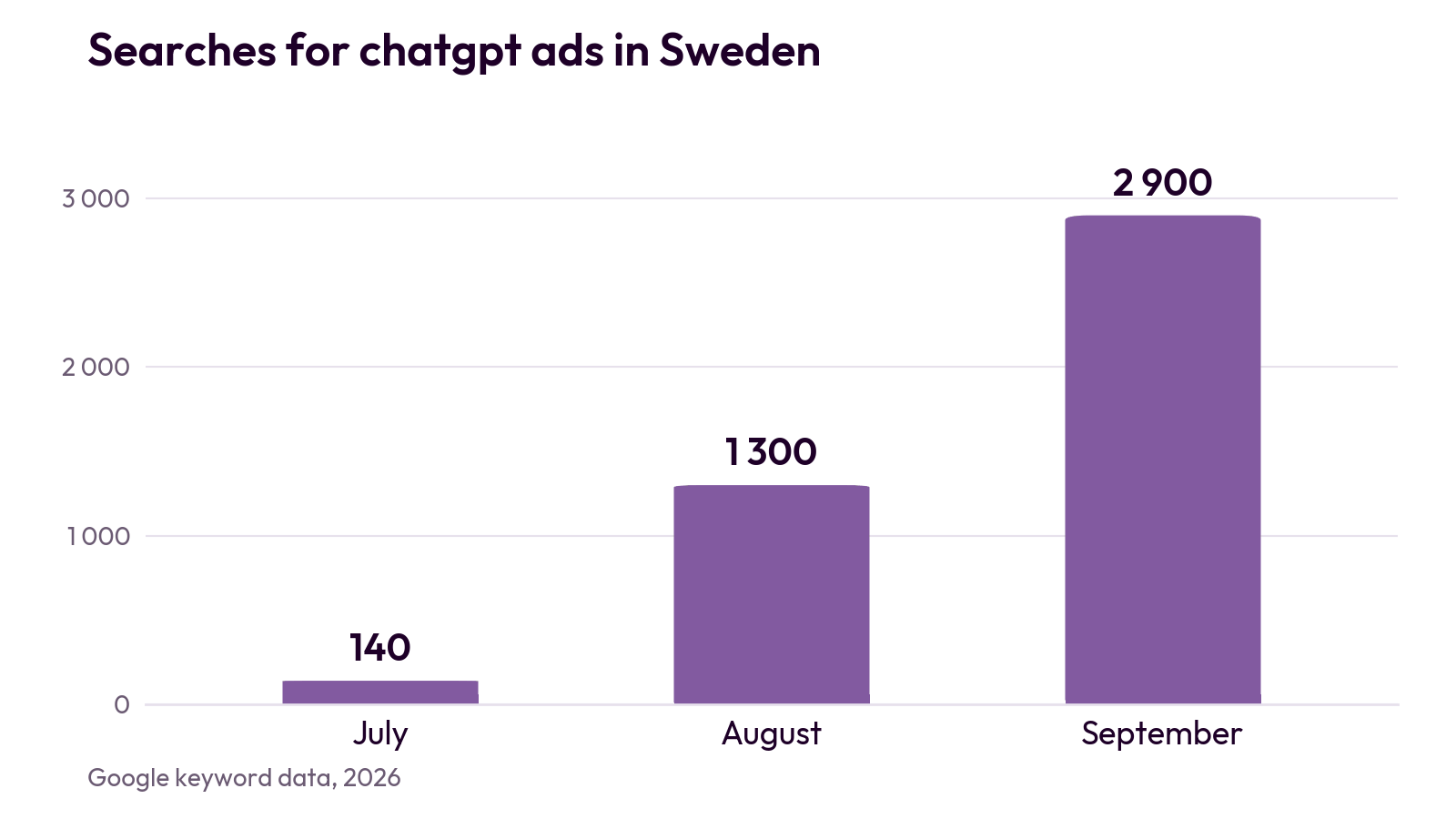
Interest is growing fast. According to Google's keyword data, searches for chatgpt ads in Sweden went from 140 in July to 1,300 in August and 2,900 in September.
What has happened and when
OpenAI has built up ads in ChatGPT at a fast pace during 2026.
- On 9 February, OpenAI began testing ads in the US for adult users of ChatGPT Free and Go.
- On 18 August, OpenAI announced that ads would come to 31 European countries the following week. Sweden was one of them.
- On 24 August, ads began appearing in Sweden. At first they could only be bought through OpenAI's ads team or through agencies and technology partners.
- On 31 August, OpenAI opened Ads Manager in Europe. There, advertisers create and manage their campaigns themselves.
- In October, OpenAI wrote that more than 100,000 advertisers had used the platform and that ads were then available in 89 countries.
How the ads are shown
The ad appears below the answer in ChatGPT. It is labelled as sponsored and kept separate from the answer. The ad shows the advertiser's name and logo, a headline, a short text and an image.

OpenAI says the ads do not affect the answers and that they run in separate systems. Advertisers cannot shape, rank or change what ChatGPT answers. Nor does an ad mean that OpenAI recommends the advertiser.
Ads are only shown to adult users of Free and Go. Anyone who pays for Plus, Pro, Business, Enterprise or Edu sees no ads. Ads are also not shown next to sensitive topics such as health, mental health and politics.
The advertiser never sees the conversations. What comes back is aggregated statistics such as impressions and clicks.
Everything in this section is based on OpenAI's help pages as of October 2026.
The ads build on what is on your website
You don't buy keywords as you do in Google Ads. Instead, OpenAI picks an ad based on expected relevance and looks at the conversation, the ad's headline and text and the page the ad leads to. When personalised ads are switched on, signals from the person's wider use of ChatGPT are also taken into account.
Advertisers can also write context hints. These describe the needs and situations the offer suits.
According to OpenAI, the hints are broad signals and not exact keywords. Nor do they guarantee that the ad appears in a particular conversation.
That is why the page behind the ad matters so much. OpenAI reviews landing pages with its crawler OAI-AdsBot and requires that it is allowed in robots.txt.
How to allow OAI-AdsBot
Robots.txt is a text file in the root of your website that tells crawlers which pages they may visit. For example.com, it is found at example.com/robots.txt.
If the file blocks OAI-AdsBot today, add these lines.
User-agent: OAI-AdsBot
Allow: /
You only need the lines if the file blocks the crawler today. If the file has no rules for OAI-AdsBot and does not shut out all crawlers, the crawler can already get in. If the file shuts out all crawlers, the lines above are enough because a crawler follows the rules that name it.
OpenAI has several crawlers, each with its own rules in robots.txt.
- GPTBot collects content that may be used to train OpenAI's AI models.
- OAI-SearchBot fetches pages for the search feature in ChatGPT.
- ChatGPT-User visits pages when a user asks ChatGPT to. According to OpenAI, robots.txt may not apply to it.
- OAI-AdsBot reviews the landing pages for ads.
A rule only applies to the crawler it names. So you can allow OAI-AdsBot and still block GPTBot.
OpenAI recommends that advertisers allow OAI-SearchBot as well. According to OpenAI, bot protection from services such as Cloudflare can stop the crawlers even when robots.txt lets them in.
The ad can be rewritten with text from the landing page
When the feature OpenAI calls creative enhancements is switched on, the system can rewrite the headline and text so that the ad fits the conversation better. It then draws on content from the landing page.
Since the end of October 2026, the feature has been on by default in new and existing campaigns unless you switch it off in Ads Manager. The new versions can be shown without you approving each one. What is on your website thus becomes part of the ad.
My recommendation is therefore to review your landing pages before you advertise. Check that the following is clear and correct.
- What you offer.
- Who the offer is for.
- Which terms apply.
Being named in the answer is something else
Visibility in AI search is about your company being named and recommended in the answer itself. In ChatGPT, that place cannot be bought. It is built with what is on your website and what others write about you.
| Question | Ad in ChatGPT | Named in the answer |
|---|---|---|
| Where do you appear? | In a paid placement below the answer, labelled as sponsored | In the answer ChatGPT writes itself |
| Who sees it? | Adult users of Free and Go | All users, whatever their plan |
| How do you get the place? | You pay for it in Ads Manager | It cannot be bought and is built with content on your website and elsewhere |
| How long do you appear? | As long as you pay | The mention rests on content that stays in place |
| How do you measure it? | Your own UTM parameters and OpenAI's measurement pixel | The source chatgpt.com in Google Analytics |
My assessment is that the difference in who sees it matters most for B2B. Many buyers probably use ChatGPT at work through Business or Enterprise. No ads are shown there at all.
Who the ads suit
Ads in ChatGPT suit you when buyers ask ChatGPT before they buy and when you have a clear page to send them to.
- Online retailers with clear product pages can build campaigns straight from their product feed.
- Service companies whose customers compare options can take the visitor straight to booking or a quote.
- Companies that are missing from the answers today can be seen while the content is built up.
They suit you less well if your buyers mostly use paid accounts. The same goes for health companies because the ads are not shown next to health topics.
How to measure the ads
Start by separating ad clicks from visits that come from the answers themselves. OpenAI lets you add your own UTM parameters to ad links. These are the codes that tell Google Analytics where a visit came from, and they are passed along with every click.

Visits from the answers have chatgpt.com as their source in Google Analytics. In the guide to tracking AI traffic in Google Analytics 4, I show how to group them in a channel of their own together with traffic from Gemini, Claude and Perplexity.
For the actual sales, OpenAI has its own measurement pixel and a Conversions API. They show whether visitors buy, send an enquiry or sign up after the click. Track the cost per sale and compare it with your other channels before you spend more.
One thing cannot be measured. You never see what the person asked because the conversations stay with OpenAI. The landing page and your own conversions are therefore what you have to go on.
Where to start
Organic visibility is the foundation and ads are an add-on. What is on your website affects both what ChatGPT says about you and what your ads say. Work on your content therefore pays off in both places.
Do you know today whether your company is named when customers ask ChatGPT, Gemini and Claude? My recommendation is to start there.
Where you are missing, build the content. Where there is a clear page to send the visitor to, you can test ads in ChatGPT on a small scale and track the sales. While the content grows, ads in Google can also cover the questions where you are missing.
How we work with visibility in AI search and Google Ads is described on our services page.

Daniel Masajada is the founder of DigitalMassa and has worked with search since 2010.
Want to know where you stand?
The audit shows how you appear in Google and which questions in AI search mention your competitors instead of you. Free for 28 more days. Valued at 15 500 SEK.
Read more
 How to Track AI Traffic in Google Analytics 4How to group traffic from ChatGPT, Perplexity, Gemini and other AI services into its own channel in Google Analytics 4. With the setup step by step and a ready-made regex.
 How to Improve Your Search Ads in Google AdsHow search advertising in Google Ads works and what to improve first, from keywords and ad copy to Quality Score, landing pages and tracking. With answers to common questions.